Seluai, Our First Tree
This is the first tree we adopted.
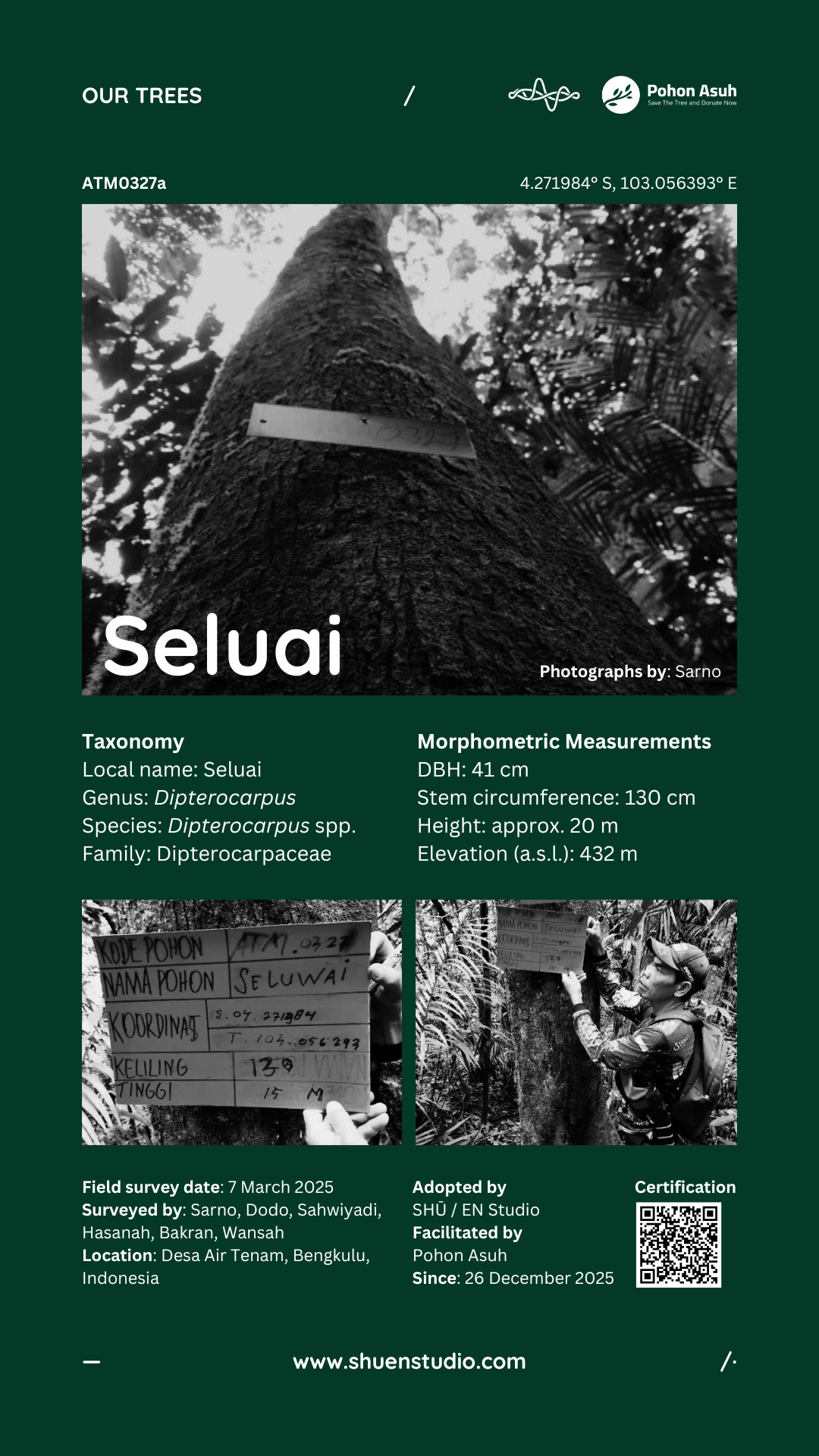
It stands in Sumatra. We know exactly where, because someone went there, measured it, wrote its name on a board, and tied that board to its trunk. The coordinates were recorded. The height was estimated. The diameter was measured by hand.
Locally, the tree is called Seluai. Scientifically, it belongs to the Dipterocarpus genus, trees that usually don’t grow alone and don’t function as background. They shape the forest around them.
This Seluai is about twenty meters tall. Its trunk measures over forty centimeters in diameter. In forests like this, trees of this kind often act as structural anchors. Other plants grow around them. The soil holds better. The forest organizes itself with them in place.
Earlier this year, a small team conducted a field survey at the site. They took photos, logged measurements, and documented the tree as part of an adoption program. Nothing fancy—just real data, written boards, muddy shoes, and people doing the work.
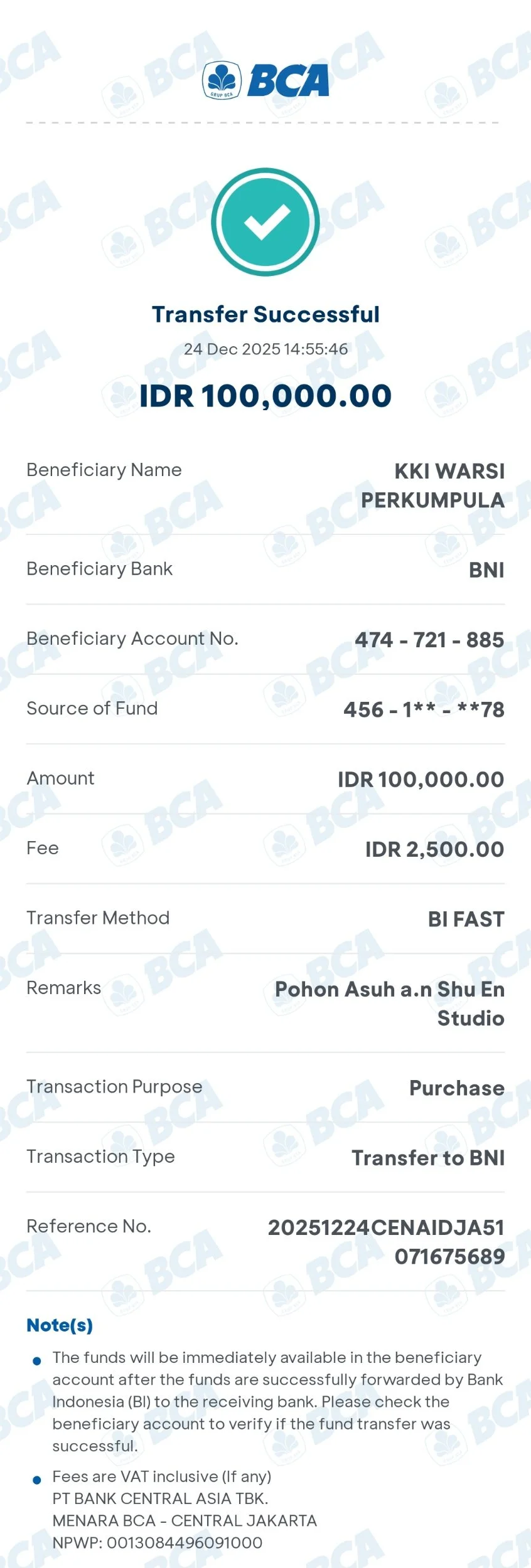
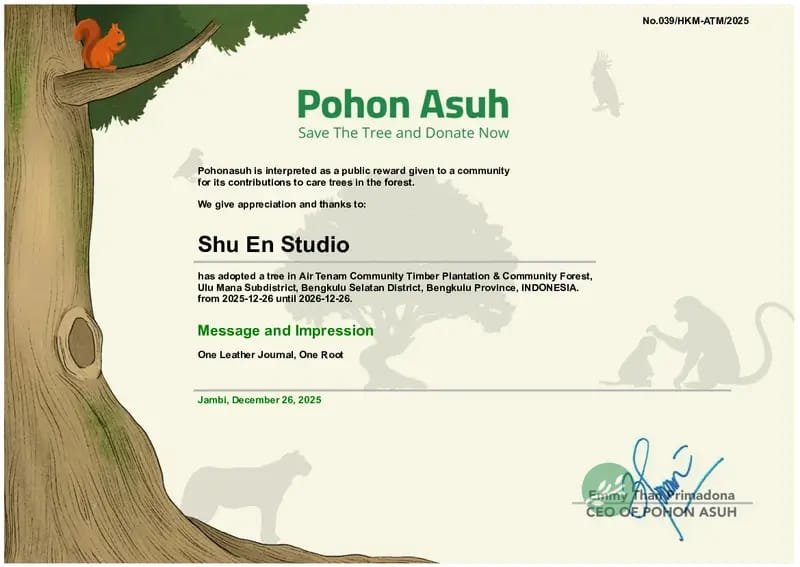
From Shu En’s profit, IDR 100,000 was allocated to adopt this tree. That amount covered the documentation process, field survey, and custodianship. The proof of payment and the adoption certificate are included below, alongside the field records.
There is something exciting about knowing a tree this way. Not as an idea, but as a specific presence. A tree you can point to and say: that one. That exact one.
This tree doesn’t symbolize anything big. It doesn’t cancel out anything. It’s simply there, continuing to grow, doing what trees like Seluai do—holding the forest together in ways that are easy to overlook if you don’t stop to look.
This is our first one.
More will follow, as the work allows. For now, this Seluai stands as a starting point, and honestly, that already feels like something worth sharing.